Microchipping Your Dog in Australia: Rules, Costs and Why It's Not Enough
Pet AWOL
Heads-up: Pet AWOL wrote this. We make QR pet tags, so we have a stake in the "tag" side of this story. Everything about the law is linked to the government or RSPCA page it came from, checked on 30 October 2026. This is general information, not legal advice, so check with your council if you're unsure.
Microchipping is the law for dogs almost everywhere in Australia, and it's one of the best things you can do for a dog that gets lost. But a lot of owners treat the chip as the whole plan. It isn't. Here's what the rules are, what it costs, and the gap a microchip leaves open.
Is microchipping compulsory?
Yes, for dogs in every state and the ACT. The Northern Territory has no territory-wide rule, but the City of Darwin requires it and other councils can too.
| State or territory | When your dog must be microchipped | Law |
| NSW | By 12 weeks, or before sale or transfer | Companion Animals Act 1998 |
| ACT | By 12 weeks, or before sale or transfer | Domestic Animals Act 2000 |
| Queensland | Between 8 and 12 weeks | Animal Management (Cats and Dogs) Act 2008 |
| South Australia | By 12 weeks, or within 28 days of getting the dog if that's later; before sale | Dog and Cat Management Act 1995 |
| Victoria | Before council registration (compulsory from 3 months), and before sale or giving away | Domestic Animals Act 1994 |
| Western Australia | By 3 months, or before transfer to a new owner | Dog Act 1976 |
| Tasmania | By 6 months | Dog Control Act 2000 |
| Northern Territory | No territory-wide rule; in the City of Darwin it's a condition of registration | Council by-laws |
Sources: state and territory government pages (listed at the end) and the RSPCA Australia Knowledgebase. Some working and hunting dogs are exempt in some states, so check with your council if that's you.
In most states, microchipping and council registration are two separate steps. A chip on its own doesn't mean your dog is registered.
What it costs
The microchip. Prices vary by vet, so ring around. The Tasmanian Government says microchipping on its own may cost between $40 and $70, and can be as cheap as $20 when it's done alongside other treatment like vaccinations or desexing. Councils and animal welfare groups often run cheaper microchipping clinics too.
Registration in NSW. This is a separate, one-off fee paid to the NSW Pet Registry:
- $84 for a dog, due at 12 weeks or when it first changes owners
- $25 late fee if you don't pay within 28 days
- An extra fee at six months if your dog isn't desexed
- $0 for a desexed dog adopted from a council pound, shelter or approved rehoming group, and for assistance dogs, working dogs and dogs in NSW Government service, like police dogs
Fines in NSW. Not microchipping can mean a $180 on-the-spot fine, and a court can impose up to $880.
Other states set their own fees, so check your council's website.
How a microchip gets your dog home
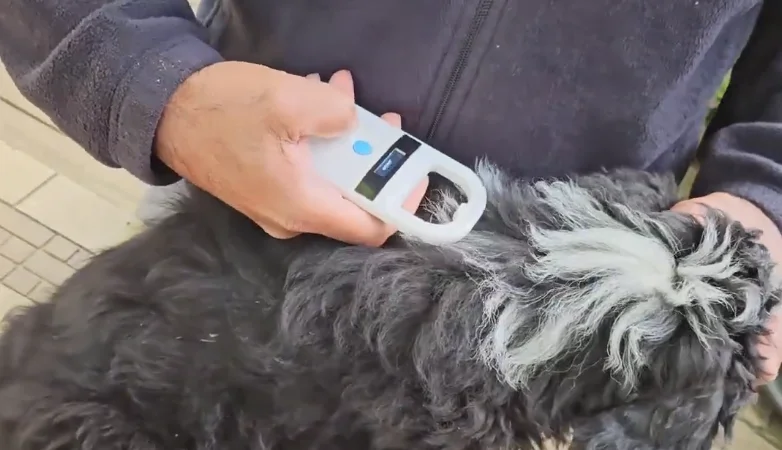
A microchip is about the size of a grain of rice and sits under the skin between the shoulder blades. It doesn't track your dog and it has no battery. It just holds a number. Here's what has to happen for that number to reach you:
1. Someone finds your dog.
2. They take it to a vet, call the council, or wait for a ranger to collect it.
3. Someone with a scanner reads the chip.
4. They look up the number on the registry.
5. The registry has your current phone number, and they call you.
Every one of those steps has to work. Notice where a tag fits: Woollahra Council's first advice to anyone who finds a dog is to check for an ID tag and phone the owner. A vet or the council comes after that.
Why a microchip isn't enough on its own
Nobody can read it without a scanner. The kind neighbour who finds your dog on the footpath can't read a microchip. Their only options are to drive to a vet, call the council, or keep your dog until someone can help.
It depends on opening hours. Dogs don't get out on a schedule. If yours slips the gate at 7pm on a Saturday, the local vet may be shut until Monday. Pounds keep limited hours too. Hornsby's pound is open on Saturdays from 9.30 to 11.30am and on Sundays from 7 to 9am, and says releases won't be processed outside those hours. That can mean your dog spends the night, or the weekend, with a stranger or in a pound while you're out searching, even though its details were on record the whole time.
Your details have to be right. A 2015 study of stray dogs entering RSPCA Queensland shelters found 37% of microchipped dogs had problems with their microchip data, most often a chip still registered to a previous owner, wrong or disconnected phone numbers, or a chip that was never registered. Of the microchipped dogs with correct details, 87% went home. With data problems, that dropped to 69%. Dogs with no chip at all fared worst: only 37% were reclaimed.
So the chip clearly helps. It's just slow, and it only works if someone can get your dog to a scanner and your details are current.
Keep your details current, and add a tag
Check your microchip details now. Find your chip number on your vet records or adoption papers and look it up on your state or registry database. Update it whenever you move, change your number or rehome a dog. If you adopted, make sure the chip has been transferred into your name.
Buying or adopting in NSW? Since 1 July 2019, anyone selling or giving away a dog must include an ID number in the ad: a microchip, breeder or rehoming organisation number. Look it up on the NSW Pet Registry before you commit.
Add an ID tag. A tag fills the gap a microchip leaves. Anyone who finds your dog can contact you straight away, from the footpath, at any hour, without a scanner or an open vet.
A standard engraved tag puts your phone number on the collar. A QR tag like ours links to a profile you control. The finder scans it with their phone camera, no app needed, and gets a masked number that puts them through to you without seeing yours. They can also share their location in one tap, and you get a text when the tag is scanned. If you change your number, you update the profile instead of buying a new tag.
Use both. A tag only helps while it's on the collar, and a chip only helps once someone reaches a scanner. The microchip is the permanent record, and the tag is the fast way home.
FAQ
Is microchipping compulsory for dogs in Australia?
Yes, in every state and the ACT. In most states your dog needs a chip by about three months old (the law says 12 weeks in some states and 3 months in others). Tasmania allows until 6 months. The NT has no territory-wide rule, but the City of Darwin requires it.
Does a microchip track my dog?
No. A microchip has no battery or GPS. It holds a number that a vet, council or shelter reads with a scanner, then matches to your details on a registry.
Is microchipping the same as registering my dog?
No. In NSW and most other states they're two separate steps. In NSW, registration is a one-off $84 fee for a dog, or $0 for a desexed dog adopted from a pound, shelter or approved rehoming group.
My dog is microchipped. Does it still need a tag?
We'd say yes. A microchip can only be read with a scanner, which usually means a vet, council or shelter, and they're not always open. A tag lets whoever finds your dog contact you straight away.
Sources
All checked 30 October 2026.
- RSPCA Australia Knowledgebase – Is microchipping mandatory for cats and dogs? (page updated 24 January 2024): rules and laws by state and territory, NSW ID number rule for ads
- ACT City Services – Dog owner responsibilities: all dogs must be microchipped, separate from registration
- Business Queensland – Microchipping laws for the sale of cats and dogs: microchip between 8 and 12 weeks
- Legal Services Commission of SA – Law Handbook, microchipping: by 12 weeks or within 28 days of possession, before sale
- Agriculture Victoria – Microchipping of dogs and cats: microchip before registration (from 3 months) and before sale or giving away
- WA Government – Microchipping cats and dogs: dogs by 3 months, and before transfer to a new owner; microchipping doesn't register them with the council
- City of Darwin – Pet registration and microchipping: microchipping is a condition of registration
- NSW Office of Local Government – Pet registration fees: $84 dog registration, $25 late fee, desexing fee, $0 categories
- NSW Office of Local Government – Microchipping and registration: 12-week rule, $180 fine, $880 court maximum
- Tasmanian Government – Microchipping FAQs: $40–$70 microchipping cost, from $20 with other treatment, working and hunting dog exemptions
- Lancaster, Rand, Collecott and Paterson (2015), Problems Associated with the Microchip Data of Stray Dogs and Cats Entering RSPCA Queensland Shelters, Animals 5(2): 37% data problems, 87% / 69% / 37% reclaim rates
- Woollahra Council – Lost and found animals: check for a tag and phone the owner first
- Hornsby Council – Lost and found pets: call council or take the dog to a vet, pound hours